MECIP
A new business structure where companies and contributors both hold a lasting share of what the AI they build produces.
A proposal. Nothing is built yet.
Ray here. This site is Governance Arc, and I post as @governance_arc on X.
Research
Before the design, the problem. My paper, The AI Attribution Trap: Why Current Measurement Regimes Cannot Settle Who Deserves Value, argues that the agentic economy has payment rails but no allocation rules. The better our measurement gets, the more precisely we track where value flows, and the more completely we fail to say where value belongs.
ARL Scorecard
I scored eight agentic payment stacks against the Allocation Readiness Level (ARL) scale defined in the paper (§6.1). Median ARL: 1 — zero of eight reach ARL 3+. Payment rails exist everywhere; the allocation layer is missing everywhere. No stack publicly separates measurement weight from capital power (C3).
Companies already pay for AI training data. One publisher offered authors $2,500 per book, once, for a three-year term. Shutterstock pays contributors from a shared pool, periodically, once that pool is large enough. Adobe pays an annual bonus to its stock contributors.
These are real payments. But each one either happens only once, or is decided by the platform, or is open only to people who already contribute to that platform.
MECIP asks what the durable version looks like.
What this could look like for one person
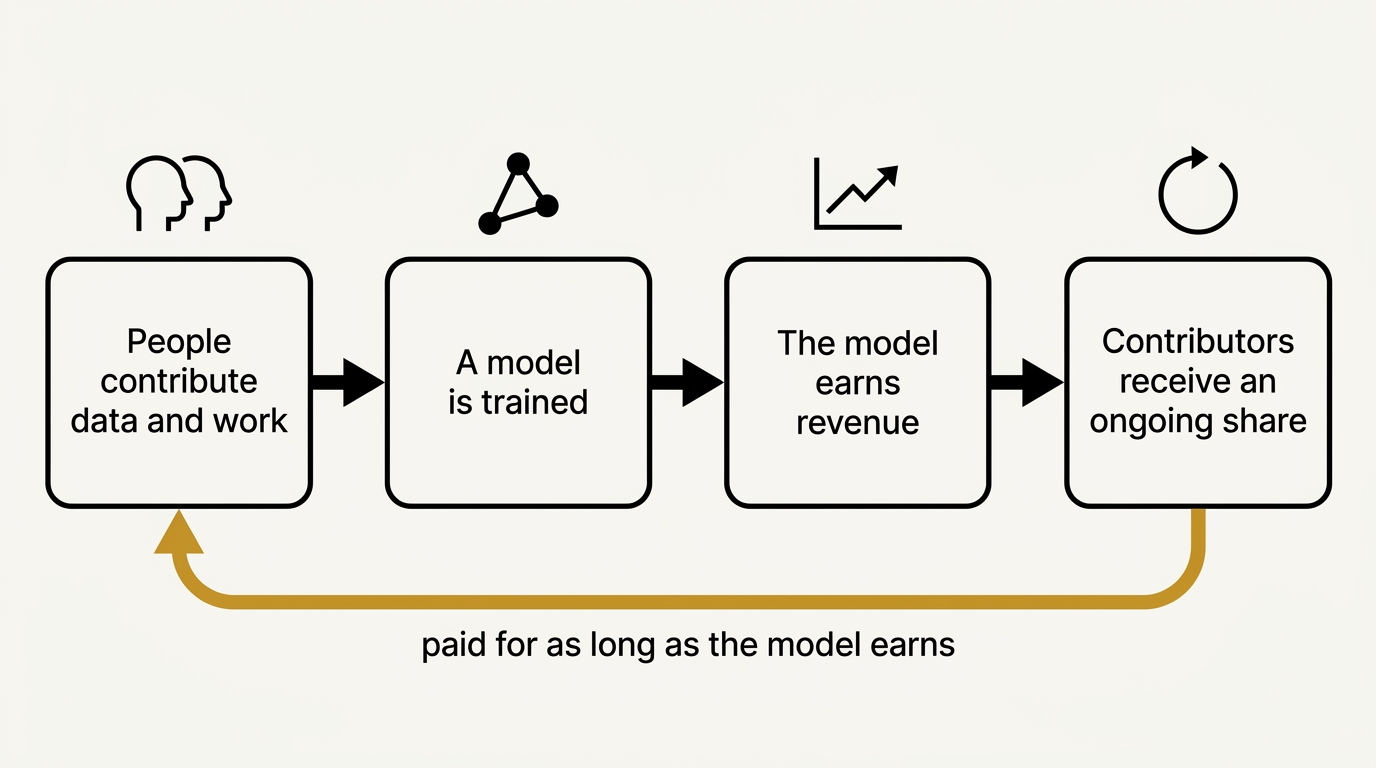
Suppose something you made (a book, a photo, a body of code) is in the training data. Under the arrangements that exist today, you are paid a flat fee once, while the model keeps earning for as long as it is used. What I want to know is what a durable version would still be paying you in year four, long after that single payment.
| How it pays | Who sets the amount | What you need first | |
|---|---|---|---|
| Book licensing | One flat fee, fixed term | Agreed once | A publishing contract |
| Adobe Firefly | Annual bonus | A 12-month licensing-volume formula | Be an Adobe Stock contributor |
| Shutterstock Fund | Periodic payout from a shared pool | Shutterstock decides | Be a Shutterstock contributor |
| MECIP (design only) | Ongoing | A structure agreed in advance | No platform to join |
Other rows describe programs that run today. The MECIP row describes a design.
How MECIP is designed to work
- A contributor would receive an ongoing share of what they help the model produce. I designed that share as a continuing distribution, so it can be paid over time without creating an employment relationship.
- The share is designed to stay away from speculative markets. Nothing is issued and nothing trades. I designed it to work as an ordinary contract.
- The right to use compute can travel with the contribution. A contributor could schedule and direct a defined amount of compute, and own that right.
- Taking part should leave your employment classification and your current job unchanged.
The detailed statutory mapping and templates are in the full write-up, shared on request.
Doesn't Shutterstock already do this?
It pays, and that is real. But the payout comes from a shared pool, paid periodically once that pool is large enough. And you have to be one of its contributors. The version I am after has none of those three limits.
Would contributors become employees?
No. Participation is designed so that it does not alter anyone's employment classification, and does not affect an existing job.
Does this need a new law first?
No. It is designed to work under the law as it stands.
Is any of this running today?
No. The core legal and economic design is drafted. Nothing is implemented, and nobody has been paid through it. That is the honest state of it.
Where this stands
The core legal and economic design is drafted. Nothing is built yet, and no one has been paid through it. I am looking for people who will try to break it. If you see a structural flaw, I want to hear it.
Reach me: DM @governance_arc on X, or email rm@ai-governance-arc.org
About
Ray. I work independently on AI value distribution and mechanism design. MECIP is the project. Governance Arc is where I write about it.
I am not at a lab and not funded by one. My own data is somewhere in these training sets too, and I was never paid for it. That is why I started on this.
What I want is a design a company would adopt because it works. That turns out to be a much harder problem than showing that the current arrangement is unfair.